Introducing NINJIO Insights: A New Era of Human Risk Visibility
Key Takeaways
- Measure resilience, not just failure. NINJIO Insights shifts reporting from who clicked to how behavior is improving, giving organizations a clear view into whether users are getting better at recognizing and responding to threats.
- Real-time visibility transforms decision-making. Embedded analytics deliver live insights into training performance, phishing behavior, and risk trends, allowing security teams to act immediately instead of relying on static, outdated reports.
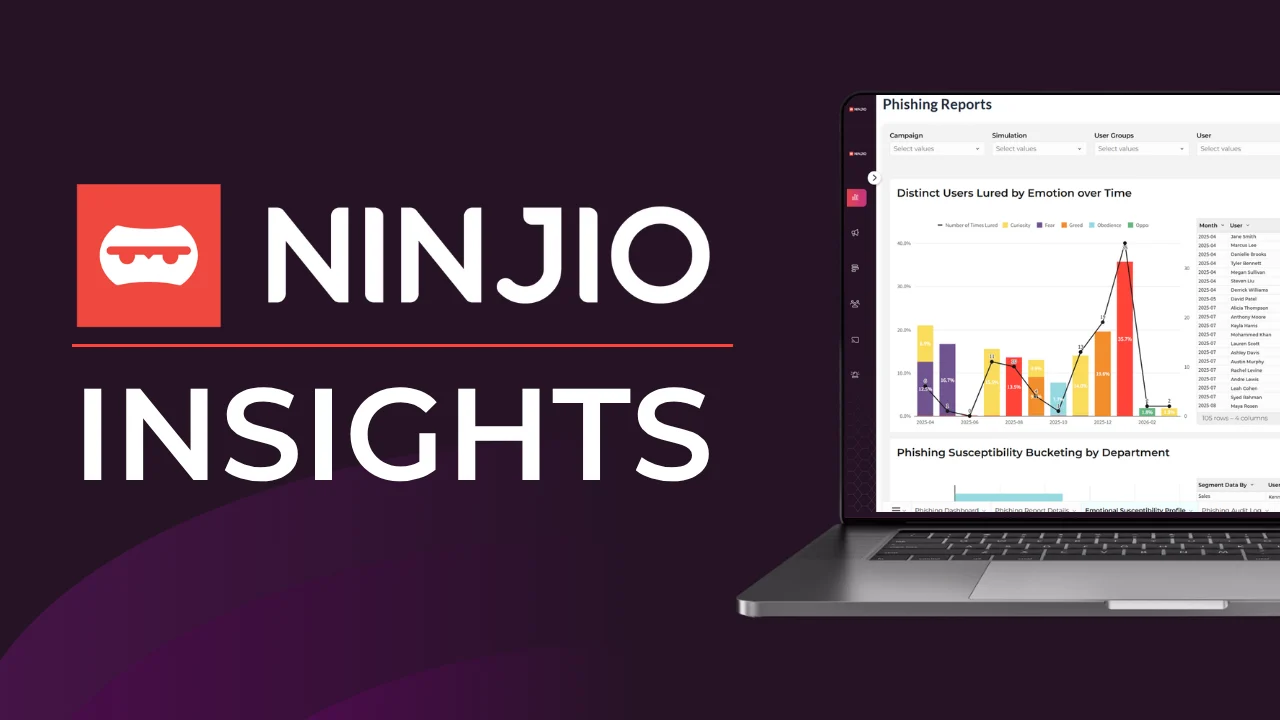
- Emotional insight reveals why users fall for attacks. The organizational Emotional Susceptibility Profile shows which emotional manipulations are working on your workforce to give you a deeper understanding of human risk.
Introduction
Security awareness training programs have long been measured by what goes wrong. Click rates. Failure rates. Missed training videos. But those metrics only tell part of the story.
They tell you where someone failed. They do not tell you whether your organization is getting stronger.
Today, NINJIO is changing that.
We are excited to announce NINJIO Insights, a next-generation reporting and analytics experience built in partnership with Snowflake and Sigma. Designed to give organizations real-time visibility into human risk, NINJIO Insights shifts the focus from failure rates to measurable resilience.
This is not just a better reporting dashboard. It is a fundamentally better way to understand human cyber behavior, quantify progress, and prove that your security awareness program is working.
Moving Beyond Failure-Based Metrics
When every metric points to what went wrong, security awareness training programs become synonymous with mistakes. It reinforces a negative loop where users feel like the problem, leadership sees only risk, and the program itself is reduced to tracking breakdowns.
That framing does not build stronger organizations. It just documents their weaknesses.
What we need to build, and measure, is resilience.
Not just whether someone failed in a moment, but whether they are improving over time. Whether they recognize threats faster. Whether they respond more confidently. Whether the organization is getting harder to manipulate.
This is where NINJIO Insights changes the conversation. Instead of centering reporting on failure, it centers it on progress. Instead of isolating incidents, it tracks behavioral trends. Instead of asking “who messed up,” it answers “are we getting better?”
Because security awareness should not feel like a report card full of red marks. It should feel like a system that is strengthening the organization over time.
Three of our key metrics in NINJIO Insights are:
Training Engagement
Training Engagement measures how actively users participate in and interact with security awareness training, not just whether they completed it.
A user can click through a course and learn nothing. But engagement tells you whether they are actually paying attention, absorbing content, and building awareness. From a resilience standpoint, this is foundational. If users are not engaged, they are not learning. And if they are not learning, behavior will not change.
High engagement signals that your program is resonating. It means users are more likely to retain information, recognize threats, and apply what they have learned in real situations.
It is the difference between checking a box and building capability.
Report Rate
Report Rate measures how often users correctly identify and report suspicious emails or phishing simulations.
This is one of the clearest indicators of active defense. A resilient organization is not one where no one clicks. It is one where users see something and say something. Report Rate shows whether employees are participating in security, not just being tested by it.
As this metric improves, it reflects a shift in mindset: From passive recipients of threats to active participants in defense. Higher report rates mean threats are identified earlier, security teams can respond faster, and risk is reduced across the organization.
Time-to-Report
Time-to-Report measures how quickly users report a suspicious email after receiving it, because speed is everything in modern attacks.
The difference between a report in 30 seconds and a report in 30 minutes can determine whether a threat is contained or spreads. Time-to-Report is a direct measure of awareness in action. It shows not just that users recognize threats, but that they prioritize responding to them quickly.
As this metric improves, it indicates that users are becoming more confident, more decisive, and more aligned with security expectations.
Time-to-LURE
Time-to-Lure measures how quickly a user interacts with a phishing email, such as clicking a link or engaging with the content. This metric provides critical insight into user susceptibility.
It helps answer an important question: Are users pausing to evaluate, or reacting impulsively?
A longer Time-to-Lure is a positive signal. It means users are slowing down, thinking critically, and applying what they have learned before taking action. This reflects a deeper behavioral shift.
Over time, increasing Time-to-Lure shows that users are becoming less reactive to manipulation and more resistant to social engineering tactics.
The Emotional Susceptibility Profile: Turning Behavior into Insight
Most security awareness training program reporting stops at the surface. It tells you what happened. It tells you who clicked.
But it does not tell you why.
The organization’s Emotional Susceptibility Profile in NINJIO Insights changes that. At its core, it identifies which emotional triggers are most effective against your employees and where your organization is most vulnerable to social engineering tactics. Because attackers do not rely on randomness. They rely on psychology.
With the Emotional Susceptibility Profile, organizations gain a clear view into the emotional patterns behind user actions. Instead of treating every failure the same, security teams can understand the underlying cause of that behavior and respond accordingly.
At the individual level, the Emotional Susceptibility Profile directs NINJIO SENSE to deliver precision coaching that targets the specific triggers users struggle with. At the organizational level, it gives program administrators and executives a finger on the emotional pulse of the organization as it reacts to simulated and real cyber threats.
Powered by Snowflake and Sigma
Delivering this level of visibility requires more than dashboards. It requires a modern data foundation. NINJIO Insights is built in partnership with Snowflake and Sigma to ensure that every insight is fast, scalable, and accessible.
Snowflake provides the underlying data infrastructure, enabling secure, high-performance processing across large and complex datasets. Whether you are analyzing a single campaign or millions of data points across a global organization, performance remains consistent and reliable.
Sigma brings that data to life through an intuitive, cloud-native analytics interface. With a familiar, spreadsheet-like experience, users can explore data, build reports, and answer questions without needing specialized technical skills.
Together, these technologies eliminate the traditional barriers to reporting.
No complex data pipelines.
No dependency on external BI tools.
No waiting on engineering teams to build custom dashboards.
Instead, security teams get immediate access to the data they need, in a format they can actually use.
From Cost Center to Business Enabler
Security awareness has historically been treated as something that exists primarily to satisfy compliance. That perception is rooted in how programs have been measured.
When reporting focuses on failures, the narrative becomes about risk, gaps, and exposure. It reinforces the idea that security awareness is a defensive cost center.
By focusing on measurable improvement and behavioral progress, NINJIO Insights allows organizations to demonstrate the positive impact of their programs.
Security leaders can now show:
- How quickly users are improving their ability to recognize threats
- How response times are decreasing across the organization
- How specific training initiatives are driving measurable change
- How overall human risk is trending over time
This reframes security awareness as a driver of organizational resilience, not just a reducer of failure. It becomes something that contributes to business outcomes. Something that can be measured, communicated, and continuously improved.
Frequently Asked Questions
A: NINJIO Insights is an embedded reporting and analytics experience within the NINJIO platform that provides real-time visibility into security awareness training, simulated phishing, and overall human risk management. It brings together behavioral data, training performance, and phishing outcomes into a single, unified view so organizations can understand how their people are improving over time.
A: Traditional reporting focuses on static metrics and past failures, such as who clicked or who failed a phishing simulation. NINJIO Insights takes a different approach by focusing on resilience. It helps organizations measure how behavior is changing over time, how quickly users recognize threats, and how effectively they respond. This allows security teams to track progress, not just problems.
A: The Emotional Susceptibility Profile is NINJIO’s behavioral analysis framework that identifies which emotional triggers are most effective against employees. By understanding whether users are more susceptible to urgency, authority, curiosity, or incentive-based attacks, organizations can move beyond surface-level metrics and gain insight into why users fall for threats. This enables more targeted training, more effective simulations, and stronger long-term behavioral change.
A: NINJIO Insights is designed for CISOs, security awareness program managers, compliance teams, and executive stakeholders who need clear, actionable visibility into human cyber risk. It is especially valuable for organizations that want to demonstrate program effectiveness, improve user behavior, and align security awareness efforts with business outcomes.
A: NINJIO Insights provides audit-ready reporting with direct access to underlying training and phishing data. Teams can generate automated reports, export data for stakeholders, and drill down into specific records as needed. This makes it easier to meet regulatory requirements, satisfy cyber insurance expectations, and demonstrate continuous improvement in risk reduction.
About NINJIO
NINJIO’s human risk management platform reduces cybersecurity risk through personalized security coaching, engaging awareness training, and adaptive testing. Our multi-pronged approach to risk mitigation focuses on the latest attack vectors to build employee knowledge and the behavioral science behind social engineering to sharpen users’ intuition. Our simulated phishing and coaching tools build a proprietary Emotional Susceptibility Profile for each user to identify their specific social engineering vulnerabilities and change behavior.