Human Cybersecurity in the AI Era: What AI Means for Employee Risk and Security Awareness Training
Key Takeaways
- AI has fundamentally expanded the human attack surface. While phishing, vishing, and social engineering aren’t new, Generative AI enables attackers to personalize and scale these attacks faster than ever before.
- The human element remains cybersecurity’s greatest challenge. More than 60% of breaches still involve people, making employee awareness one of the most important security controls organizations have.
- Shadow AI introduces a second layer of risk. Employees are rapidly adopting AI tools outside approved workflows, creating new data privacy, governance, and compliance concerns.
- Organizations need more than annual awareness training. Modern cyber defense requires policies that encourage responsible AI use, technologies that detect AI-enabled attacks, and continuous, engaging employee education.
- Building human resilience requires a layered approach. A strong cybersecurity foundation starts with the NINJIO Core Four, expands through AI-specific training, and is reinforced with realistic simulations that prepare employees for modern phishing and vishing attacks.
AI has become one of the fastest-adopted workplace technologies in history. Employees use it to write emails, summarize meetings, analyze documents, create presentations, and automate everyday work. Organizations are racing to deploy AI to increase productivity and remain competitive.
All while cybercriminals are doing the same thing.
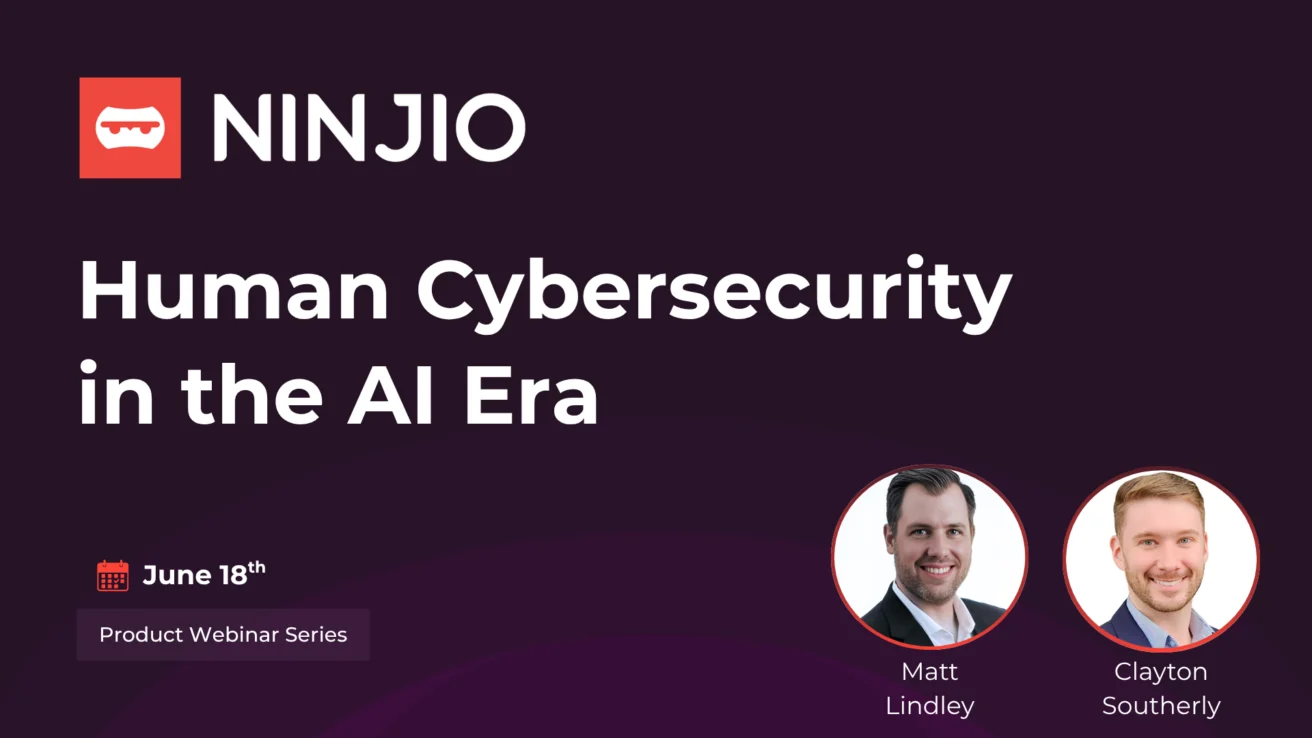
During NINJIO’s recent webinar, Human Cybersecurity in the AI Era, Chief Innovation & Information Security Officer Matt Lindley explained why AI hasn’t fundamentally changed cybercrime. Instead, it has amplified the effectiveness of the attacks security leaders have been fighting for years.
The result is a dramatically larger human attack surface.
Attackers can now generate convincing phishing emails in seconds, clone voices for vishing campaigns, personalize social engineering attacks at scale, and continuously improve malicious content using the very same Generative AI technologies organizations are encouraging employees to adopt.
The challenge isn’t simply defending against AI. It’s helping employees recognize how AI is changing the way attackers exploit normal human behavior.
AI Supercharges Social Engineering
Many discussions around AI security begin with futuristic scenarios and cutting-edge attack vectors. Those are important, but organizations should begin somewhere much more familiar: Phishing. Business email compromise. Phone scams. Credential theft.
These attack vectors continue to dominate successful breaches because they exploit something technology has never eliminated: human emotion.
According to Verizon’s 2026 Data Breach Investigations Report, more than 62% of breaches involve some aspect of the human element, while phishing continues to account for the majority of social engineering attacks. At the same time, AI-linked phishing campaigns have surged dramatically, allowing attackers to produce highly personalized content at unprecedented speed.
Instead of inventing completely new attack categories, Generative AI accelerates proven ones.
Matt described this progression as three connected stages:
- Criminals continue using timeless emotional manipulation techniques.
- AI allows them to generate polished, personalized attacks almost instantly.
- Those attacks spread across every point of the human attack surface, including email, messaging platforms, phone calls, and video.
What previously required hours of reconnaissance and writing can now be accomplished in moments. That changes the economics of cybercrime.
Organizations should expect more attacks, better attacks, and far more personalized attacks than traditional awareness programs were designed to address.
The Human Attack Surface Is Growing Faster
Technology teams often focus on endpoints, identities, cloud infrastructure, and applications. But they need to think about another attack surface that is expanding just as quickly: People.
Employees now interact with AI dozens of times throughout the workday. They receive AI-generated emails, collaborate with AI assistants, consume AI-generated content, and increasingly make business decisions alongside AI systems.
Attackers understand this shift. As organizations embrace AI, cybercriminals gain more opportunities to impersonate coworkers, executives, vendors, and customers using convincing synthetic content.
Humans are emotional before they are rational. AI doesn’t change that. It accelerates threats and expands the attack surface.
Traditional security awareness training often focuses on helping employees identify obvious indicators of phishing or malware. But today’s attacks frequently remove those obvious indicators altogether.
Grammar mistakes disappear. Branding becomes flawless. Messages arrive with highly personalized context.
The technology has changed, but human psychology has not. That means cybersecurity awareness training must evolve beyond spotting suspicious emails to teaching employees how AI manipulates trust itself.
Shadow AI Is Creating a New Category of Human Risk
AI adoption isn’t only changing how attackers operate. It’s changing how employees work.
Throughout the webinar, Matt discussed the rapid rise of Shadow AI, referring to employees using unapproved AI tools without organizational oversight.
The numbers are difficult to ignore:
- 59% of employees report using unapproved AI tools for work.
- Organizations now average 67 AI applications.
- More than half of employees admit entering sensitive business information into personal AI accounts.
- Shadow AI already appears in a meaningful percentage of modern breaches.
None of these behaviors necessarily come from malicious intent. Most employees simply want to work faster. So security leaders shouldn’t view AI adoption as something to stop, but instead should focus on helping employees understand:
- Which AI tools are approved.
- What information should never be shared.
- How AI providers handle sensitive data.
- How responsible AI use protects both productivity and the organization.
Modern security awareness programs must support innovation while reducing unnecessary risk.
Human Cyber Defense Requires Policy, Tools, and Training
Throughout the webinar, Matt emphasized that organizations cannot rely on a single control to address AI-enabled threats. Instead, effective human cyber defense requires three complementary pillars:
Policy
Organizations need clear, practical AI acceptable use policies that encourage responsible innovation instead of discouraging AI adoption altogether.
Tools
Security technologies must evolve to identify AI-enabled phishing, deepfakes, impersonation attacks, and other threats that traditional defenses may miss.
Training
Employees need engaging security awareness content and realistic simulations that prepare them for AI-powered attacks before they encounter them in the real world.
When these three elements work together, organizations create a cybersecurity culture that reduces human risk without slowing innovation.
Build a Strong Foundation with the Core Four
AI has changed the delivery mechanism for social engineering, but it hasn’t changed the psychological tactics attackers rely on. That’s why every security awareness program still needs a strong foundation.
NINJIO’s Core Four provides that baseline by focusing on the behaviors employees use every day, regardless of how attackers package their campaigns. The course includes four foundational episodes covering:
- Deepfake Video
- Credential Stuffing
- AI-Powered Phishing
- Social Engineering
These topics establish a common cybersecurity vocabulary across the organization while teaching employees how to recognize manipulation instead of simply memorizing attack indicators.
That distinction becomes increasingly important as Generative AI makes phishing emails, fake videos, and impersonation attacks nearly indistinguishable from legitimate communications.
Rather than treating AI as a completely separate problem, the Core Four helps employees understand the timeless principles behind modern attacks so they’re prepared regardless of which technology criminals use next.
Expand Beyond the Basics with the AI Training Pack
For organizations embracing AI throughout the business, foundational awareness isn’t enough.
Employees also need guidance on the unique risks introduced by Generative AI itself.
NINJIO’s AI Training Pack extends the Core Four with targeted episodes that address today’s most important AI-enabled attack techniques, including:
- AI Impersonation Attacks
- Prompt Injection Attacks
- Malicious AI Bots
- Generative AI Hygiene
- AI Data Privacy
- Deepfake Audio Scams
Together, these episodes help employees understand both sides of the AI equation.
They learn how attackers weaponize AI through increasingly sophisticated social engineering while also developing safe habits for using approved AI tools responsibly in their own work.
As Matt emphasized during the webinar, organizations don’t need employees to stop using AI. They need employees to use AI securely.
The AI Training Pack gives security teams a practical way to reinforce that mindset as AI adoption continues to accelerate.
Why Organizations Need Vishing Simulation Training
Voice phishing, or vishing, has become one of the fastest-growing forms of social engineering.
Unlike traditional phishing emails, vishing attacks use phone calls, AI-generated voices, and real-time conversation to create urgency, establish trust, and persuade employees to reveal sensitive information or approve fraudulent requests.
Advances in Generative AI have made these attacks dramatically more convincing. Attackers can now clone voices, impersonate executives, and create realistic conversations that are difficult for employees to distinguish from legitimate communications.
While many organizations regularly test email phishing awareness, far fewer prepare employees for attacks that happen over the phone or through collaboration platforms.
That gap is becoming increasingly important as cybercriminals combine phishing emails, messaging apps, and voice conversations into coordinated, multi-stage social engineering campaigns.
How the NINJIO Sensei AI Vishing Simulator Works
To help organizations prepare for these emerging threats, NINJIO developed the Sensei AI Vishing Simulator.
Rather than limiting simulations to email, the platform creates realistic AI-powered voice conversations that challenge employees to recognize manipulation in real time. Organizations can launch multi-stage attack scenarios that begin with a phishing email before transitioning into simulated Microsoft Teams or Zoom conversations with an AI-generated caller, closely mirroring how today’s attackers operate.
Because these conversations are dynamic instead of scripted, employees practice responding to realistic social engineering techniques such as urgency, authority, impersonation, and emotional manipulation without exposing the organization to actual risk.
Why AI-Powered Vishing Simulations Matter
The goal of vishing simulations isn’t simply to see whether employees answer the phone.
It’s to build confidence recognizing suspicious requests before credentials are shared, payments are approved, or sensitive information is exposed.
Combined with the Core Four and AI Training Pack, the Sensei AI Vishing Simulator helps organizations prepare employees for one of the fastest-growing areas of human cyber risk. It extends awareness beyond the inbox and gives security teams a practical way to measure and strengthen employee resilience against AI-enabled voice phishing and multi-channel social engineering attacks.
Final Thoughts
Artificial intelligence isn’t replacing traditional cyber threats. It’s making them faster, more scalable, and more convincing.
That means organizations must rethink how they prepare employees for the future.
As Matt Lindley explained throughout the webinar, protecting the human attack surface requires more than technical controls. It requires helping people recognize manipulation, use AI responsibly, and build the confidence to respond appropriately when attackers inevitably reach them.
Organizations that combine clear AI policies, modern detection tools, engaging awareness training, and realistic simulations will be best positioned to reduce human cyber risk while enabling employees to embrace AI safely.
The future of cybersecurity isn’t just about defending technology. It’s about strengthening the people who use it.
Frequently Asked Questions
Generative AI allows attackers to create highly personalized phishing emails, vishing attacks, deepfakes, and other social engineering campaigns at unprecedented speed and scale. Rather than replacing existing attack methods, AI amplifies their effectiveness.
The human attack surface includes every interaction where people can be manipulated into making security mistakes, including email, messaging platforms, phone calls, collaboration tools, AI assistants, and other digital communications.
Shadow AI refers to employees using AI applications that haven’t been approved by their organization. While often well intentioned, Shadow AI can expose sensitive information, create compliance challenges, and increase cybersecurity risk.
The Core Four is NINJIO’s foundational cybersecurity awareness course covering Deepfake Video, Credential Stuffing, AI-Powered Phishing, and Social Engineering. It provides employees with the core behaviors needed to recognize and respond to today’s most common cyber threats.
The AI Training Pack expands foundational awareness with additional training covering AI impersonation attacks, prompt injection, malicious AI bots, Generative AI hygiene, AI data privacy, and deepfake audio scams, helping organizations build AI-specific security awareness.
Vishing simulation recreates realistic voice phishing attacks in a controlled environment so employees can practice identifying AI-generated voices, impersonation attempts, and social engineering tactics before encountering them in real attacks.