Phishing Simulation Program Best Practices Guide

Key Takeaways: Phishing Simulation Program Best Practices
- Run phishing simulations at least twice per month to enable real behavioral change
- Vary phishing test difficulty to mirror real attacker tactics
- Identify emotional susceptibility to target training more effectively
- Always explain why users clicked, not just that they did
- Measure reporting behavior and response time, not just click rates
- Train beyond email, including vishing and multi-channel social engineering
What is a Phishing Simulation?
Phishing simulations and phishing tests are critical because phishing remains the most common initial attack vector in cybersecurity incidents. According to the Verizon 2025 Data Breach Investigations Report, 60% of breaches involve a human element. This persistent threat means that protecting the human layer is fundamental to a solid cybersecurity posture.
Additional data from the Anti-Phishing Working Group (APWG) shows that phishing attacks continue to grow in volume and sophistication year over year. Similarly, the UK National Cyber Security Centre consistently identifies phishing as the most common form of cyberattack impacting organizations.
Despite this, many phishing simulation programs fail to drive real behavior change. They measure clicks, generate reports, and move on. They tell organizations that a user failed a phishing test, but not why. This creates a compliance-driven program rather than a behavior-driven one, where the point is to create a metric instead of informing the training program that changes behavior.
A modern phishing simulation program must be continuous, psychologically informed, and grounded in the emotional intelligence behind social engineering attacks.
Here are the best practices for a phishing simulation program in 2026’s threat landscape:
1. Run Phishing Tests at Least Twice a Month
One of the most common mistakes organizations make is underestimating how often employees need exposure to phishing tests. Running phishing simulations quarterly or even monthly is not enough to influence behavior in a threat landscape that evolves daily.
And human memory doesn’t work on a quarterly schedule. Research on the Ebbinghaus forgetting curve shows knowledge decays quickly without reinforcement, and Verizon’s 2025 DBIR data put a concrete number on this gap: Employees trained within the previous 30 days were four times more likely to report a phishing attempt than those who hadn’t received recent cybersecurity awareness training.
NINJIO’s proprietary data from our platform finds that at least monthly phishing simulations helps real security outcomes.
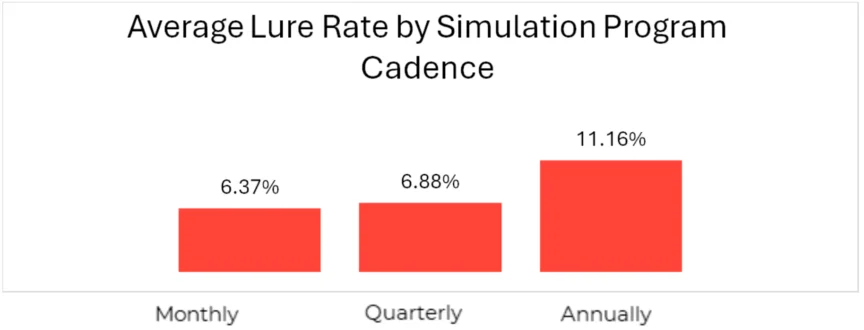
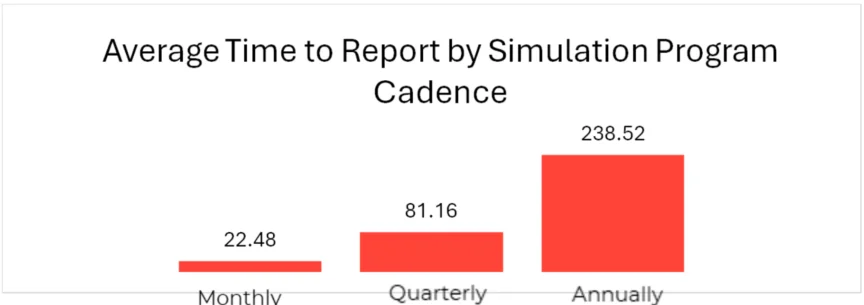
Organizations should run phishing simulations at least twice per month. This cadence helps normalize phishing tests as part of everyday work rather than an isolated event. It also reduces the emotional spike associated with testing, making employees less defensive and more receptive to learning. And if your program uses the behavioral data from phishing simulations to inform the rest of your human risk management framework, running simulations twice a month generates the data needed to reduce risk more quickly.
2. Adjust Phishing Test Difficulty to User Ability
Phishing simulations must reflect the reality that phishing attacks are not uniform. Data from the FBI’s Internet Crime Complaint Center shows that social engineering attacks vary widely in sophistication, from basic scams to highly targeted business email compromise.
An effective phishing simulation program includes a range of difficulty levels. Basic phishing tests help reinforce obvious red flags, while more advanced phishing simulations introduce contextual realism, urgency, and personalization. As trainees get better at spotting easier simulations, they should graduate to something harder.
This layered approach ensures that employees do not rely on a single detection method. Instead, they develop a deeper understanding of attacker behavior and adapt to increasingly complex threats.
3. Phishing Test Data Should Explain WHY Users Click
Most phishing simulation programs focus on one key metric: lure rate. And while it’s important to understand who might click on a real phishing attack and reduce that number over time, it’s not enough.
That metric misses the most important factor in behavior change: understanding why a user clicked on the phishing simulation.
Phishing attacks succeed because they exploit human psychology. Emotional triggers such as urgency, fear, obedience, and curiosity drive decision-making. A user who clicks is often responding exactly as the attacker intended.
Effective phishing simulations also rely on those emotional manipulations. When each simulation is tied to those emotions, the program can build an individual emotional susceptibility profile for each person, telling the system why someone may fall for a social engineering attack. That way, we can send the right training to the right person to reduce risk.
4. Phishing Simulations Must Test Emotional Manipulation
A defining characteristic of modern phishing simulation programs is the ability to uncover emotional susceptibility. Not all users respond to phishing attacks in the same way. Some are more vulnerable to urgency, others to greed, curiosity, or fear.
NINJIO’s methodology focuses on identifying and training against the core emotional triggers that attackers exploit. These include:
- Urgency: Pressure to act quickly without thinking
- Fear: Threats of consequences such as account loss or disciplinary action
- Curiosity: Temptation to view unexpected or intriguing content
- Obedience: Requests appearing to come from leadership or IT
- Sociality: Familiar brands, coworkers, or known contacts
- Greed: Financial incentives or rewards
- Opportunity: Exciting new potential, like promotions or the chance to succeed
By mapping phishing simulation results to these emotional triggers, organizations can identify patterns across their workforce and tailor personalized security coaching accordingly.
NINJIO’s emotionally intelligent methodology emphasizes:
- Avoiding shame and blame in phishing simulation results
- Reinforcing positive behaviors such as reporting
- Using storytelling to create emotional engagement
This approach aligns with behavioral science research, showing that people change behavior more effectively when they feel supported and understand the emotional context of their decisions.
5. Measuring Phishing Simulation Success: Beyond Click Rates
Click rates alone do not provide a complete picture of phishing simulation effectiveness. Guidance from CISA and NIST encourages organizations to measure resilience rather than failure.
Report Rate
Report Rate measures how often users correctly identify and report suspicious emails or phishing simulations.
This is one of the clearest indicators of active defense. A resilient organization is not one where no one clicks. It is one where users see something and say something. Report Rate shows whether employees are participating in security, not just being tested by it.
As this metric improves, it reflects a shift in mindset: From passive recipients of threats to active participants in defense. Higher report rates mean threats are identified earlier, security teams can respond faster, and risk is reduced across the organization.
Time-to-Report
Time-to-Report measures how quickly users report a suspicious email after receiving it, because speed is everything in modern attacks.
The difference between a report in 30 seconds and a report in 30 minutes can determine whether a threat is contained or spreads. Time-to-Report is a direct measure of awareness in action. It shows not just that users recognize threats, but that they prioritize responding to them quickly.
As this metric improves, it indicates that users are becoming more confident, more decisive, and more aligned with security expectations.
Time-to-Lure
Time-to-Lure measures how quickly a user interacts with a phishing email, such as clicking a link or engaging with the content. This metric provides critical insight into user susceptibility.
It helps answer an important question: Are users pausing to evaluate, or reacting impulsively?
A longer Time-to-Lure is a positive signal. It means users are slowing down, thinking critically, and applying what they have learned before taking action. This reflects a deeper behavioral shift.
Over time, increasing Time-to-Lure shows that users are becoming less reactive to manipulation and more resistant to social engineering tactics.
This is where behavioral metrics evolve into operational insight. Patterns of repeated clickers can identify systemic risk concentrations, while growth in report rates and faster escalation times signal a strengthening human detection layer—effectively turning employees into an active part of the security operations function.
6. Phishing Simulations Beyond Email: Vishing and Multi-Channel Attacks
Modern phishing simulations must extend beyond email. Attackers increasingly use multi-channel approaches, including voice phishing (vishing), SMS phishing, and collaboration tools like Teams or Slack.
FBI Internet Crime Complaint Center data shows that phishing and business email compromise schemes are among the most financially damaging cybercrimes, often incorporating phone-based social engineering.
Training employees to recognize vishing attacks is essential. Users should be taught to:
- Question unsolicited phone requests
- Verify identities using known contact methods
- Resist urgency and pressure tactics
- Report suspicious interactions
By incorporating vishing awareness into phishing simulations, organizations prepare employees for the full spectrum of social engineering threats.
7. Building a Security Culture
Phishing simulations and phishing tests should not exist in isolation. They must be part of a broader effort to build a security-first culture.
The ultimate goal of Human Risk Management is not compliance. It’s integration. Effective programs embed cybersecurity into overall company performance, aligning security behaviors with business outcomes. Employees begin to see security as part of doing their jobs well, not as an external burden imposed by IT.
This mindset shift is critical. A culture of cybersecurity thrives when employees feel empowered, trusted, and equipped to defend the organization. Instead of fearing mistakes, they participate actively in detection, reporting, and response.
Establishing a culture of cybersecurity requires more than tools and policies. It requires addressing emotional vulnerabilities, embracing personalization, and delivering engaging, human-centered learning experiences. When organizations adopt Human Risk Management, cybersecurity stops being a box to check and becomes a shared responsibility—and a competitive advantage.
Conclusion: Building Cyber Resilience with Phishing Simulations
An effective phishing simulation or phishing test program is not about catching employees making mistakes. It is about helping them make better decisions.
By running phishing simulations at least twice per month, varying difficulty, uncovering emotional susceptibility, and expanding training to include vishing, organizations can significantly reduce human risk.
When combined with NINJIO’s emotionally intelligent methodology, phishing simulations become a powerful driver of long-term resilience.