Why Speed Matters: Reducing Mean Time to Detect Social Engineering Threats

Key Takeaways
- Speed is the difference between a close call and a breach: In social engineering attacks, especially phishing, the window between detection and action is incredibly small. Faster identification and response directly reduce risk exposure.
- MTTD now applies to human risk, not just systems: The moment a phishing email lands, the clock starts. Reducing time to report and triage threats is critical to limiting attacker dwell time and preventing escalation.
- AI-powered triage transforms security outcomes: Automating phishing analysis enables real-time classification and response, helping security teams move from backlog to action instantly while reinforcing positive employee behavior.
In cybersecurity, speed is a defining factor of resilience. Nowhere is this more evident than in social engineering threats like phishing, where attackers exploit emotions like urgency, greed, and obedience to bypass technical controls. In these scenarios, the minutes between a phish report and someone clicking on the dangerous link are the difference between security and a breach.
The concept of Mean Time to Detect (MTTD) has traditionally been associated with system-level threats. But as social engineering becomes more sophisticated, organizations must apply the same urgency to human risk. The faster a suspicious email is identified, classified, and contained, the less time an attacker has to infiltrate, move laterally, escalate privileges, or exfiltrate data.
Reduce Cyber Risk by Cutting Time to Detect
Phishing attacks are cleverly designed to create a narrow decision window. A well-crafted message impersonating an executive or a trusted vendor can prompt an employee to act within seconds. If that action involves clicking a malicious link or sharing credentials, the clock starts ticking. The attack is designed to exploit a sense of urgency to reduce the time the employee may spend on threat detection.
We typically think about dwell time as the period during which an attacker has access to your environment. Longer dwell times correlate directly with greater financial loss, operational disruption, and reputational damage. But in reality, the dwell time starts when the phishing message lands in the first inbox, like a landmine waiting for an unsuspecting victim. That’s why increasing report rates and reducing time-to-report via effective security awareness training is important. The sooner an alarm is raised, the more time the security team has to remediate before the landmine goes off.
This is where security awareness meets technical response. While employees are trained to report suspicious emails, the backend process of analyzing and responding to those reports can be slow, manual, and inconsistent. Security teams become bottlenecked, and critical threats risk being buried in queues even if someone spotted the landmine and raised the alarm.
Connecting Phish Reporting to Rapid Response
Closing this gap requires a shift from reactive workflows to real-time intelligence. Employees can report suspected threats with precision, but true protection comes from the speed at which security teams can triage reports and remediate threats. AI-driven tools are transforming this process by dramatically reducing the time between suspected phish report and resolution. Instead of relying solely on human analysis, advanced systems can instantly classify emails, identify malicious indicators, and prioritize responses based on risk.
NINJIO Sensei AI’s Email Threat Analyzer is built with this challenge in mind. By automating suspected phishing report classification, it empowers security teams to move from triage to action in seconds rather than hours. Suspicious messages are analyzed in real time, enabling faster containment and reducing the likelihood of widespread compromise.
Why Quicker Threat Triage Cyber Resilience
Reducing MTTD goes far beyond efficiency. It fundamentally strengthens your organization’s security posture once your cybersecurity awareness training program creates a class of quick phish reporters in your workforce.
- Limiting the Blast Radius: Faster detection means fewer users exposed to the same threat. When malicious emails are identified and reported quickly, they can be removed or blocked before they spread across the organization.
- Save Time for Security Teams: Automation allows analysts to focus on high-impact decisions rather than manual sorting. This not only improves response times but also reduces burnout and error rates.
- Reinforcing Employee Behavior: When employees see rapid feedback on reported threats, it reinforces positive security behaviors. Reporting becomes a meaningful action, not a black hole.
- Disrupting Attacker Momentum: Cybercriminals rely on speed and scale. By accelerating your response, you disrupt their ability to gain a foothold and execute follow-on attacks.
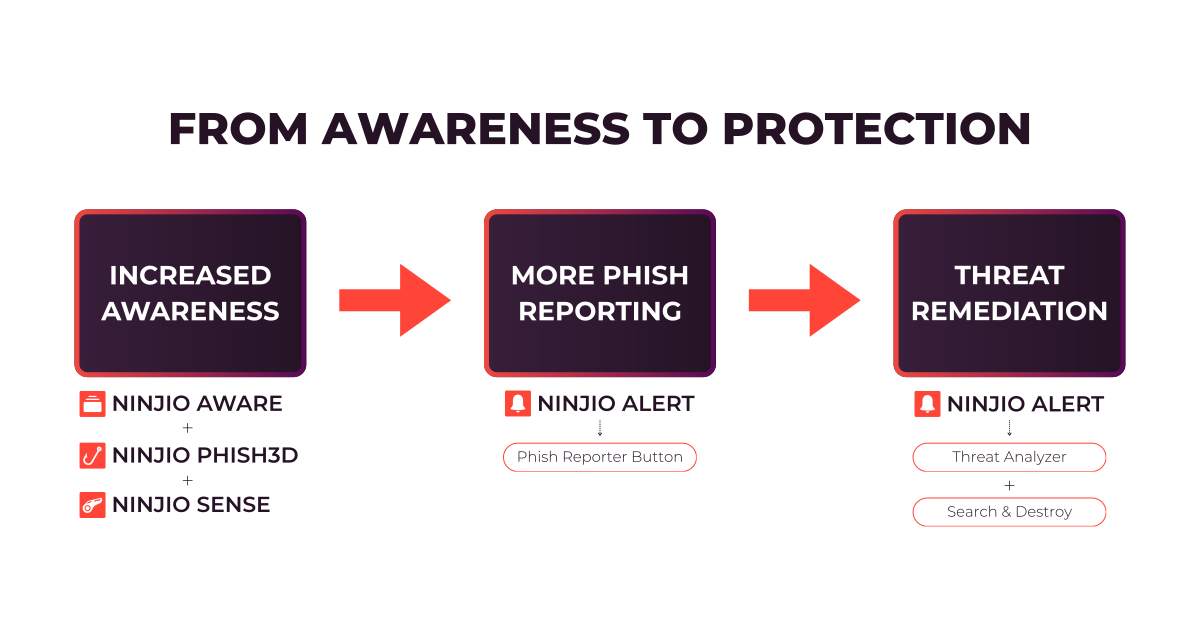
Reducing Vulnerability in Human Risk Management
As phishing attacks continue to evolve—leveraging AI-generated content, deepfakes, and hyper-personalization—the window for detection will shrink. Organizations that rely on ineffective compliance exercises and slow, manual remediation processes will find themselves increasingly vulnerable. The future of human risk management lies in combining effective cybersecurity awareness training with AI-powered speed. Tools like Sensei AI support human judgment, ensuring that when employees raise their hand, the system is ready to respond.
In the end, cybersecurity is a race against time. And when it comes to social engineering threats, the organizations that win will be the ones that detect and act first.
Frequently Asked Questions
A: MTTD measures how quickly a threat is identified after it enters an environment. In phishing, it starts when the email hits an inbox and ends when it is recognized as malicious.
A: Phishing relies on urgency and emotional triggers to prompt quick action. The faster a threat is detected and contained, the less chance an attacker has to exploit access or spread further.
A: Employees are often the first line of defense. Faster reporting increases visibility, giving security teams more time to respond before damage occurs.
A: AI automates the classification and prioritization of reported threats, reducing manual workload and enabling near-instant response times.
A: By combining effective security awareness training with AI-driven tools that streamline triage and remediation, organizations can significantly reduce detection and response delays.
About NINJIO
NINJIO’s human risk management platform reduces cybersecurity risk through personalized security coaching, engaging awareness training, and adaptive testing. Our multi-pronged approach to risk mitigation focuses on the latest attack vectors to build employee knowledge and the behavioral science behind social engineering to sharpen users’ intuition. Our simulated phishing and coaching tools build a proprietary Emotional Susceptibility Profile for each user to identify their specific social engineering vulnerabilities and change behavior.