The Human Side of Security: Doug Patteson on Risk, Trust, and the Future of Cyber Defense
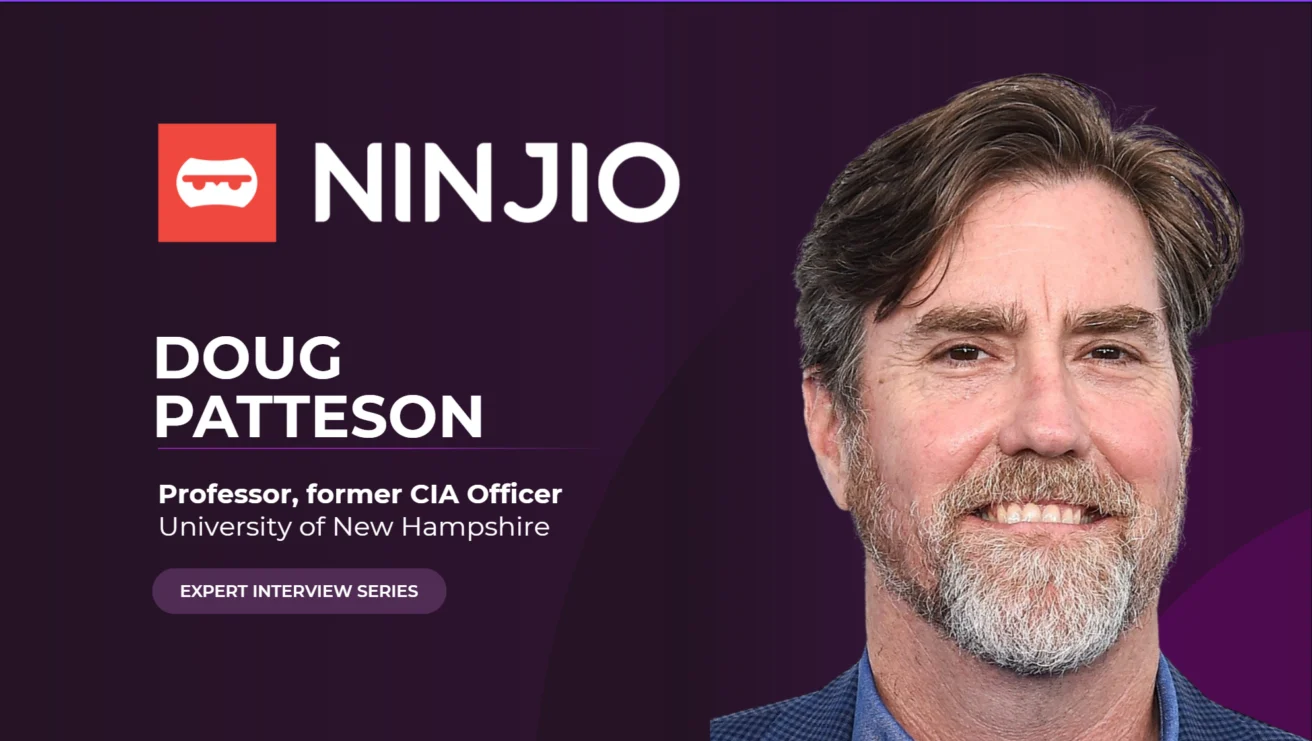
Former intelligence officer and cybersecurity leader Doug Patteson discusses why most organizations still misunderstand human behavior and how AI is reshaping social engineering.
Former intelligence officer, cybersecurity executive, leadership consultant, and now creative advisor for the hit Netflix series The Night Agent, Doug Patteson has spent decades studying one thing that technology alone can never fully solve: human behavior.
From HUMINT operations to overseeing enterprise IT and cyber functions, Patteson has seen firsthand how fear, urgency, trust, and self-interest shape the decisions people make under pressure. Today, as organizations wrestle with phishing, insider risk, AI-generated deception, and the broader challenge of human risk management, his perspective feels especially timely.
What makes Patteson’s approach different is that he doesn’t frame cybersecurity purely as an infrastructure problem. To him, security is fundamentally relational. Firewalls, monitoring tools, and automated systems matter, but culture, leadership, trust, and communication matter just as much. In an era where attackers increasingly exploit emotions instead of code vulnerabilities, that distinction becomes critical.
We sat down with Patteson to discuss the evolution of social engineering, why most organizations still misunderstand the “human layer” of security, how Hollywood gets cyber threats both right and wrong, and why AI-driven deepfakes may force leaders to rethink how trust functions inside organizations. Along the way, he shared insights on leadership, storytelling, organizational culture, and what effective human risk management actually looks like in practice.
You’ve described yourself as someone who understands the “human side” of security. From your HUMINT background, what do most organizations still misunderstand about human behavior in cyber risk?
Humans operate largely out of self-interest. That sounds cynical, but it’s reality. Most people are trying to protect themselves, their careers, their reputations, or their ability to get their work done efficiently. A lot of behavior in organizations comes from a place of fear—fear of making mistakes, fear of slowing down business, fear of looking uninformed.
Organizations often underestimate how much those emotional drivers influence security decisions in real time. We tend to think people make rational, policy-based decisions, but under stress or urgency, they often don’t. That’s why attackers focus so heavily on emotion and psychology rather than just technical exploits.
In traditional intelligence work, motivations matter as much as methods. How do you see attacker motivations evolving in today’s cyber threat landscape, and how should organizations respond?
I don’t actually think motivations have evolved all that much. Most attackers are still ultimately motivated by access to information or systems they can convert into money or leverage. What has changed dramatically are the methods and the accessibility of tools.
Criminals today have access to capabilities that were far harder to obtain even a decade ago. The scale, speed, and sophistication of attacks have accelerated. Attackers are focused on the easiest pathway to making money, and AI has lowered the barrier to entry significantly.
Organizations need to recognize that while motivations may remain consistent, the speed at which attacks can be initiated and adapted has radically changed. That requires a much faster and more adaptive security posture.
You’ve worked both in operational environments and now in storytelling with The Night Agent. How accurately do you think Hollywood portrays human-driven threats like social engineering or insider risk?
At the end of the day, Hollywood is focused on entertainment first. But that doesn’t mean it can’t portray real risks effectively. In fact, storytelling can be incredibly valuable because it gives people a framework for understanding threats emotionally, not just intellectually.
If anything, Hollywood tends to overestimate the speed at which investigators can identify or catch attackers. You’ll see scenarios where someone identifies a threat based on a tiny detail almost instantly. Real life usually doesn’t work that way. But the broader concepts around manipulation, insider risk, deception, and trust? Those are often very real. We can absolutely use entertainment and storytelling as tools to help people understand the risks they face.
Many cybersecurity programs still focus on systems rather than people. Why do organizations struggle to operationalize the “human layer” of security?
One mantra I talk about a lot is this: you solve relational problems with relationship solutions. Security is often treated purely as an infrastructure problem when it’s really both an infrastructure and a relationship problem.
It’s easier to buy technology. You can bolt on a new platform or install another system. Cultural change is much harder. It takes time, leadership commitment, and employee buy-in. Employees complain about training because they often see it as something getting in the way of their work instead of enabling it.
Frankly, I haven’t seen a lot of organizations fully solve this outside of environments where security is deeply embedded from the start. Some of the companies that emerged from the post-9/11 intelligence and defense world tend to do this better because security isn’t an add-on there; it’s foundational to how they operate.
From your leadership experience overseeing IT and cyber functions, where did you see the biggest disconnect between technical controls and real-world human behavior?
There are two examples that immediately come to mind.
The first is training. Every organization says security awareness matters, but then leaders spend enormous amounts of time chasing employees to complete required cybersecurity training. That tells you something important: many employees fundamentally believe security gets in the way of doing business.
The second example is physical security. Tailgating into buildings is still incredibly common. I know several organizations that discovered unauthorized individuals wandering around offices simply because someone politely held the door open behind them.
Technology can only go so far if the human behavior underneath it isn’t aligned.
Social engineering attacks often succeed not because of technical sophistication, but because they exploit trust, urgency, or authority. Which of these human factors do you think is most underestimated today?
In intelligence work, the answer is usually, “It depends.” But if I had to narrow it down, I’d say urgency and authority are probably the most underestimated today.
I think about a case where an employee received what appeared to be an urgent request from a CFO that supposedly originated from the CEO. The employee responded quickly because the authority and urgency combination short-circuited normal skepticism.
Attackers understand that people are conditioned to respond quickly to authority figures, especially under time pressure. That dynamic remains incredibly powerful.
NINJIO talks a lot about moving beyond compliance and toward behavioral risk insights. From your perspective, what does “effective” human risk management actually look like in practice?
It has to become part of the culture rather than a bolt-on solution.
From the top down, security needs to become part of the fabric of the organization. The more seamless it feels, the more successful it becomes. Ideally, it’s embedded so deeply into the company’s operations and behaviors that people don’t think of it as separate from how they work.
I use this analogy a lot: nobody notices roads when they’ve been resurfaced. They only notice potholes. Good security culture works the same way. The system needs to be secure, but it also needs to run quietly in the background without constantly creating friction.
In intelligence work, profiling and pattern recognition are critical. How can organizations better “profile” risk—not in a surveillance sense, but in understanding employee behavior and susceptibility?
It starts with actually knowing your people.
Organizations need to align employee motivations with security motivations. When security culture is integrated naturally into workflows, training, leadership expectations, and communication, people begin to see it as part of their shared mission rather than external enforcement.
The seamlessness matters tremendously. If employees constantly feel burdened by security processes, they disengage. But when it’s integrated effectively, the culture itself begins reinforcing better behaviors.
You’ve stepped back from a full-time role and shifted toward consulting and creative work. Has that change in perspective influenced how you think about risk, decision-making, or leadership?
In some ways it’s taken me back to where I started. Early in my intelligence career, I worked in environments where decisions had to be made quickly with incomplete information. There was constant risk and ambiguity.
Corporate environments often reduce risk significantly through structure and process. Stepping back into consulting and independent creative work has reintroduced a level of uncertainty and entrepreneurial risk into my life.
At this stage, though, I’m energized by helping other people grow. A lot of my focus now is leadership development and helping organizations think differently about culture, risk, and decision-making.
If you were advising a CISO today, what’s one thing you would tell them to stop doing— and one thing they should start doing—when it comes to managing human risk?
They should start listening much more carefully to employees. Employees will often tell you where the weaknesses are if leadership is willing to hear them. Their frustrations, workarounds, and complaints contain valuable information.
What they should stop doing is assuming that a purchased system can perfectly overlay onto an organization’s culture. Every company has unique dynamics, workflows, and behaviors. Trying to apply an external solution without adapting it internally is like putting on someone else’s jacket—it never quite fits correctly.
In your experience, how important is storytelling in shaping how people perceive and respond to risk? Can narrative be a tool for better security awareness?
Storytelling and narrative are incredibly important. People respond far more strongly to stories than policies. When people understand why something matters, they’re much more likely to buy in emotionally and behaviorally.
There’s a reason concepts like “Start With Why” resonate so strongly in leadership conversations. Narrative creates meaning, and meaning drives engagement.
Looking ahead, as AI and deepfakes become more prevalent, how do you think the “human layer” of security will need to evolve over the next three to five years?
Honestly, deepfakes are terrifying from a security perspective. I recently heard about a situation involving a friend’s daughter where attackers used publicly available social media clips to replicate her voice convincingly. That’s the world we’re entering.
As these technologies improve, organizations are going to need much stronger human verification practices and much more direct engagement between leaders and teams. Trust itself is going to require new forms of validation. Technology will continue evolving rapidly, but ultimately the human layer may become even more important, not less. Because at the end of the day, attackers still succeed by manipulating people.
About Doug Patteson
Doug Patteson is a former CIA case officer, cybersecurity executive, leadership advisor, and creative consultant whose career spans intelligence operations, corporate leadership, and entertainment. After serving a decade overseas in HUMINT and counterterrorism roles, Patteson earned his MBA from The Wharton School and went on to help lead TURBOCAM International, where he served as the company’s first CFO and now advises the executive leadership team. He also consults on film and television projects, including The Night Agent, and frequently speaks and writes on leadership, intelligence, cybersecurity, and the human dimensions of risk.
LinkedIn: Doug Patteson | LinkedIn
Frequently Asked Questions
A: Compliance focuses on meeting regulatory requirements, not actual security performance. Organizations can pass audits while still being vulnerable because compliance often relies on static policies rather than real-world threat readiness.
A: Human risk refers to the potential for employees, contractors, or users to unintentionally or intentionally contribute to security incidents through behavior, decision-making, or error. It’s now a core part of the overall attack surface.
A: Instead of relying on vanity metrics, organizations should track real performance indicators like detection time, response time, recovery time, and outcomes from simulated or real-world attacks.
A: AI enables attackers to automate reconnaissance, personalize phishing at scale, and even interact with targets in real time. This makes attacks more convincing, faster to deploy, and harder to detect.
A: Organizations should move beyond static awareness training and adopt experiential, scenario-based learning that builds instinct and prepares employees to respond effectively under pressure.
About NINJIO
NINJIO’s human risk management platform reduces cybersecurity risk through personalized security coaching, engaging awareness training, and adaptive testing. Our multi-pronged approach to risk mitigation focuses on the latest attack vectors to build employee knowledge and the behavioral science behind social engineering to sharpen users’ intuition. Our simulated phishing and coaching tools build a proprietary Emotional Susceptibility Profile for each user to identify their specific social engineering vulnerabilities and change behavior.